










Products
Subtotal
€0.00
Est. delivery
FREE
Order total
€0.00

Please enter a promotion code

Sorry, the coupon code you have entered is invalid or has expired.

Finish


The benefits of subscribing

How much do I pay?

Save 10% compared to RRP by subscribing to your favourite Healthspan products.

Plus, our Price Match Promise* ensures you will always receive the best available price on your subscription products, even if the one-time purchase price on our website falls below your ongoing subscription price.

How do I sign up for Subscribe & Save?

It’s simple to subscribe to a product; just select the 'Subscribe & Save' option, choose the delivery frequency you require and click 'Set up now'. Your subscription will be added to your basket like a normal order.

After you have placed the order you will receive an email confirmation with all the details. You will then be able to see your subscription details in the ‘My Subscriptions’ page in your account area on the website too.

How do I change or delay my order?

You can change the number of packs, delivery frequency or next scheduled dispatch date of your subscriptions at any time by logging in to your account and going to My Subscriptions. You can also update your delivery address and credit card details.

Can I cancel a subscription?

Yes, you can cancel your subscription at any time by contacting our customer service team on 1800 719 056. Please note subscriptions must be cancelled 72 hours before the scheduled dispatch date to avoid any charges.

How do I return an item?

Orders can be returned within Ireland for a refund of the price paid for the product. Please note that returns must be made within 30 days of purchasing and can only be accepted if the products are unopened, undamaged and in their original packaging.

For further information please view our Returns Policy.

Where Is my order?

Orders are being processed and dispatched as normal, however, if you are concerned about the whereabouts of your order, please contact us at customercare@healthspan.ie or on 1800 719 056.

Further information can be found on our Subscribe & Save Policy and Terms & Conditions pages.


*Price match promise is based on the one time purchase price excluding new subscription discounts and voucher offers.


The route and the method by which we transport your shipment shall be at our sole discretion. We will use third party carriers to fulfil our delivery obligations to you.

The table below outlines the delivery options offered by Healthspan:


Republic of IrelandCostTarget delivery times*
Subscriptions€3.50 Approx. 1-2 working days  
Standard delivery€7.00Approx. 1-2 working days
Orders over €50.00FREEApprox. 1-2 working days

If we are unable to make a delivery of products because of an incorrect address, we will make all reasonable efforts to find the correct address. We will notify you of the correction and deliver or attempt to deliver the shipment to the correct address although additional charges may apply.

Where our carrier is unable to complete the delivery of products for whatever reason they will try to leave a notice at the receiver's address stating that delivery of products has been attempted and the whereabouts of the shipment.

Where is my order?

Orders are being processed and dispatched as normal.

If you are concerned about the whereabouts of your order, please contact us at customercare@healthspan.ie or on 1800 719 056.

For deliveries outside of Republic of Ireland please visit www.healthspan.co.uk

Could a lack of vitamin D be affecting my joint health?

Back to article list

Latest articles

Maintaining healthy joints and bones is important, but people are at risk of developing a variety of joint issues as a result of nutrient deficiencies. One particular nutrient that is essential for health – but that we often lack – is vitamin D.

Around half of people in Ireland have sub-optimal vitamin D levels – a concerning number considering these low levels have been linked to bone and joint conditions such as osteoporosis, osteomalacia (or 'soft bones') and an increased risk of bone fractures.1

The symptoms of vitamin D deficiency vary and are often quite vague – and even hidden. Nevertheless, it's essential for our health, so read on to see how to increase your intake to keep your joints healthy.

Who is at risk of vitamin D deficiency?

The latest National Adult Nutrition Survey shows that although only 6.7 per cent of adults in Ireland had levels of vitamin D low enough to be classed as a deficiency throughout the year, more than 40 per cent had levels considered by the Institute of Medicine as inadequate for bone health.2

Certain medical conditions or lifestyle choices can increase your risk further.

This includes people who get very little or no sunshine exposure, and those with darker skin, who should choose vitamin D-fortified foods and supplements all year round.3

If, as advised, you cover up in the sun and use skin products with a high sun protection factor, it's wise to take a vitamin D supplement all year round to bridge the gap.4

Those with coeliac and Crohn's disease, for example, are at risk of vitamin D deficiency because of reduced absorption from the diet.5, 6

Age is another factor. The older you get, the more difficult it becomes to synthesise vitamin D in your skin, so it's important to consider taking a vitamin D supplement to prevent deficiency.

The HSE says that children between one and four years old need 5 micrograms of vitamin D as a supplement every day for a few months each year – and recommend that this is given from Halloween (31st October) to St Patrick's Day (17th March).7

How does vitamin D affect bones?

Vitamin D plays many roles in the maintenance of strong, healthy bones. One key role is the absorption and regulation of calcium levels. Calcium is not only essential for bones, but also for muscle contraction, nerve impulses and secretion of hormones.8

Vitamin D controls how much calcium is absorbed from food into the body, as well as affecting how much calcium is excreted through the kidneys. Your body prioritises your serum calcium levels over your bones, so if there isn't enough calcium in the blood, vitamin D will remove calcium from the bones to correct it.9

This means that if you aren't getting enough vitamin D, your calcium levels may drop, which can increase your risk of osteoporosis and fractures associated with low bone mineral density.10

When you do have enough calcium, vitamin D acts directly on osteoblasts – the cells that lay down calcium in the bones. Sufficient vitamin D is therefore particularly important for building bone density, as well as maintaining it.11

However, vitamin D isn't just important for maintaining strong bones. It also plays an important role in your overall health by inhibiting many of the inflammatory processes that can occur in the body. Inflammation is both a contributing factor and an aggravating factor in many conditions, so avoiding deficiency is incredibly important.12
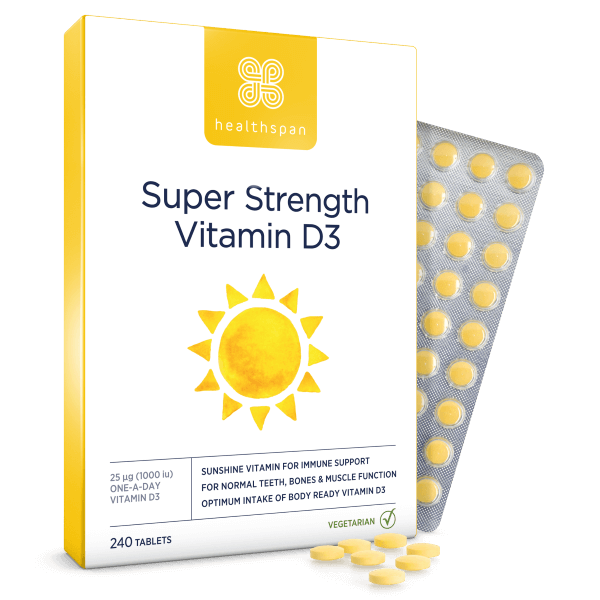
Super Strength Vitamin D3 pack

Super Strength Vitamin D3

For healthy bones, teeth, muscles and immunity

  • 25mcg vitamin D per tablet
  • Helps keep bones, teeth and muscles healthy, and supports immunity
  • Multiple health benefits from €0.06 a day
Shop now

How to boost your vitamin D levels naturally

There are plenty of ways to boost your vitamin D levels naturally. One way is through increasing sunlight exposure.

When the skin is exposed to sufficient UVB light, the body will go through the process of producing vitamin D. So, the easiest way to support vitamin D production is to get yourself out into the sun. (How long for depends on how much skin is exposed, how intense the sunlight and the colour of your skin – most experts recommend between 9 and 25 minutes, for the fairest to darkest skin tones respectively.)

However, in winter it's particularly important to consume vitamin D through your diet. Foods that contain vitamin D include eggs, oily fish and foods that are fortified with vitamin D.13 Mushrooms that are exposed to UVB rays can also contain a good amount of vitamin D.14

Taking a vitamin D supplement is a convenient way to ensure you are getting enough, particularly if you are at risk of deficiency.

Ultimately, keeping your vitamin D levels sufficient can help not only your bone health, but also your overall health. From food to supplementation, it's important to make sure you're getting enough vitamin D from a variety of sources.

Like this article? Share it!

 
References

1 University College Cork - Cork Centre for Vitamin D and Nutrition Research. Health Outcome.
2 Cashman, K., Muldowney, S., McNulty, B., Nugent, A., FitzGerald, A., Kiely, M., Walton, J., Gibney, M.J., Flynn, A. (2013). Vitamin D status of Irish adults: Findings from the National Adult Nutrition Survey. British Journal of Nutrition, 109(7), 1248-1256.
3 Health Service Executive. Vitamin D.
4 Health Service Executive. Vitamin D.
5 Li, X. X., Liu, Y., Luo, J., Huang, Z. D., Zhang, C., & Fu, Y. (2019). Vitamin D deficiency associated with Crohn's disease and ulcerative colitis: a meta-analysis of 55 observational studies. Journal of translational medicine, 17(1), 323.
6 Coeliac Society of Ireland. Key Nutritional Deficiencies.
7 Health Service Executive. Vitamin D.
8 Veldurthy, V., Wei, R., Oz, L., Dhawan, P., Jeon, Y. H., & Christakos, S. (2016). Vitamin D, calcium homeostasis and aging. Bone research, 4, 16041.
9 Veldurthy, V., Wei, R., Oz, L., Dhawan, P., Jeon, Y. H., & Christakos, S. (2016). Vitamin D, calcium homeostasis and aging. Bone research, 4, 16041.
10 Veldurthy, V., Wei, R., Oz, L., Dhawan, P., Jeon, Y. H., & Christakos, S. (2016). Vitamin D, calcium homeostasis and aging. Bone research, 4, 16041.
11 van Driel, M., & van Leeuwen, J. P. (2014). Vitamin D endocrine system and osteoblasts. BoneKEy reports, 3, 493.
12 Yin, K., & Agrawal, D. K. (2014). Vitamin D and inflammatory diseases. Journal of inflammation research, 7, 69–87.
13 Health Service Executive. Vitamin D.
14 Keegan, R. J., Lu, Z., Bogusz, J. M., Williams, J. E., & Holick, M. F. (2013). Photobiology of vitamin D in mushrooms and its bioavailability in humans. Dermato-endocrinology, 5(1), 165–176.